
Once More with Feeling...
Some thoughts on Steven Spielberg’s Disclosure Day

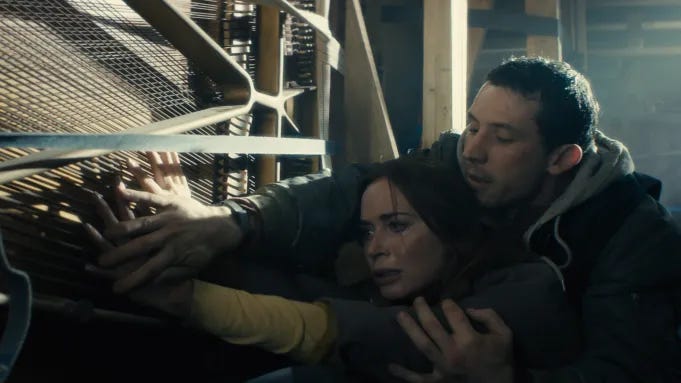
Image: Josh O’Connor and Emily Blunt in Disclosure Day, Deadline.
This post will (eventually) get into spoilers for the new film Disclosure Day
It seems obvious to say, at this point, that we are living in an age defined by widespread arrested development. It’s no trick or illusion, Michael (sorry), as a wide swath of young-ish adults (let’s call it 30-50 or so), in the light of the terribleness we have experienced in our lifetimes, have chosen to retreat into the things that brought us great joy in our youth. The endless stream of reboots, lega-sequels, and endless IP adaptations have made it feel, to many of us in this age range, that the right thing to do is reject the world and wallow in the escapism, chasing the high we felt cracking open the comic we’d biked across town to grab off the rack, or what we felt when we first slipped a life-changing VHS tape out of its rental store slipcase. Those were simpler times for us, maybe for the world, and anything that can give us a sliver of that feeling pulls us into its orbit.
To be clear, this is not a holier-than-though diatribe against this trend. As I write this, I sit surrounded by more Star Wars books and action figures than any rational 12-year-old would own, let alone a man in his 40’s. When everything is as terrible as it is, I would never want to make anyone feel bad about what they love. It’s not my scene, but I think it’s pretty awful how mocking mainstream and online media have been about the rise of self-identified “Disney Adults” and the mean-spirited way they represent a group that, to my reckoning, simply want to feel like they belong to a community. For every mocked adult obsessed with Star Wars or anime, I would easily point to a sports fanatic who exhibits the same escapist impulses when they play a fantasy sport or arrange their lives around a playoff schedule, but these have always been more acceptable.
With that disclaimer in place, I want to admit that the joys of this arrested development are wearing thin for me, like a cheap Netflix reboot that can never compare to the original. As the corporate overlords continue to churn out this fare that seems to focus mainly on making us all nostalgic, on reminding us of what used to bring us joy, and on inspiring us to buy the Funko Pops and (of course) the overpriced popcorn bucket, I find myself seeing the manipulation more than the joy. Because in the end, the goal is the consumption. Of course I will proudly bear my fan identities, but I grow tired of the measure of that identity hanging so much on how many t-shirts, toys, and high-end collectibles I buy. As this trend has continued, it becomes clearer that there’s less art and more commerce, less meaning and more advertisement. Perhaps this is never more emblematic than in the summer box office season, which for the majority of my lifetime has been interested in creating greater and greater spectacles to drive us to get the toys, the apparel, and the tie-in fast food meals (and to be clear again, I HAVE).
I actually really love the summer movie season. For those that don’t know, I am currently on a 6-year streak of completing what the internet calls the Oscar Death Race, which is making sure I view every film nominated for every Oscar, ideally before the ceremony happens. This is a great joy in my movie year, and has been a conduit for discovering international, documentary, and short films that I absolutely would have never sought out otherwise. It feeds my soul to understand more of the world and it makes me curious. But to be honest, it is almost always a SUPER BUMMER of a time, especially in categories that, by their nature, focus more on the hard realities of the human condition: war, death, suffering, really any of the four horsemen. So, when summer movie season rolls around, I am primed and ready to grab the large popcorn, tune out, and escape.
Yet I would correlate the rise of the arrested development culture directly to diminishing returns (metaphorical, but also literal) in the blockbuster culture of summer as fans DO NOT EAT the dove. As we get more and more poorly-developed, overly-mined, or haphazardly-produced franchise fare, I just feel less and less. Even when these movies are of strong quality, and some still are, they don’t really transport me back to my youth, and even when they do, I find it a cheap thrill, good for an afternoon, but disposable. The chicken and egg of whether the studios created this IP mania or the fans did through market demand is likely unsolvable, but it feels like we’ve hit the crest of the wave and are starting to see it crash down in a big splash of “meh.”
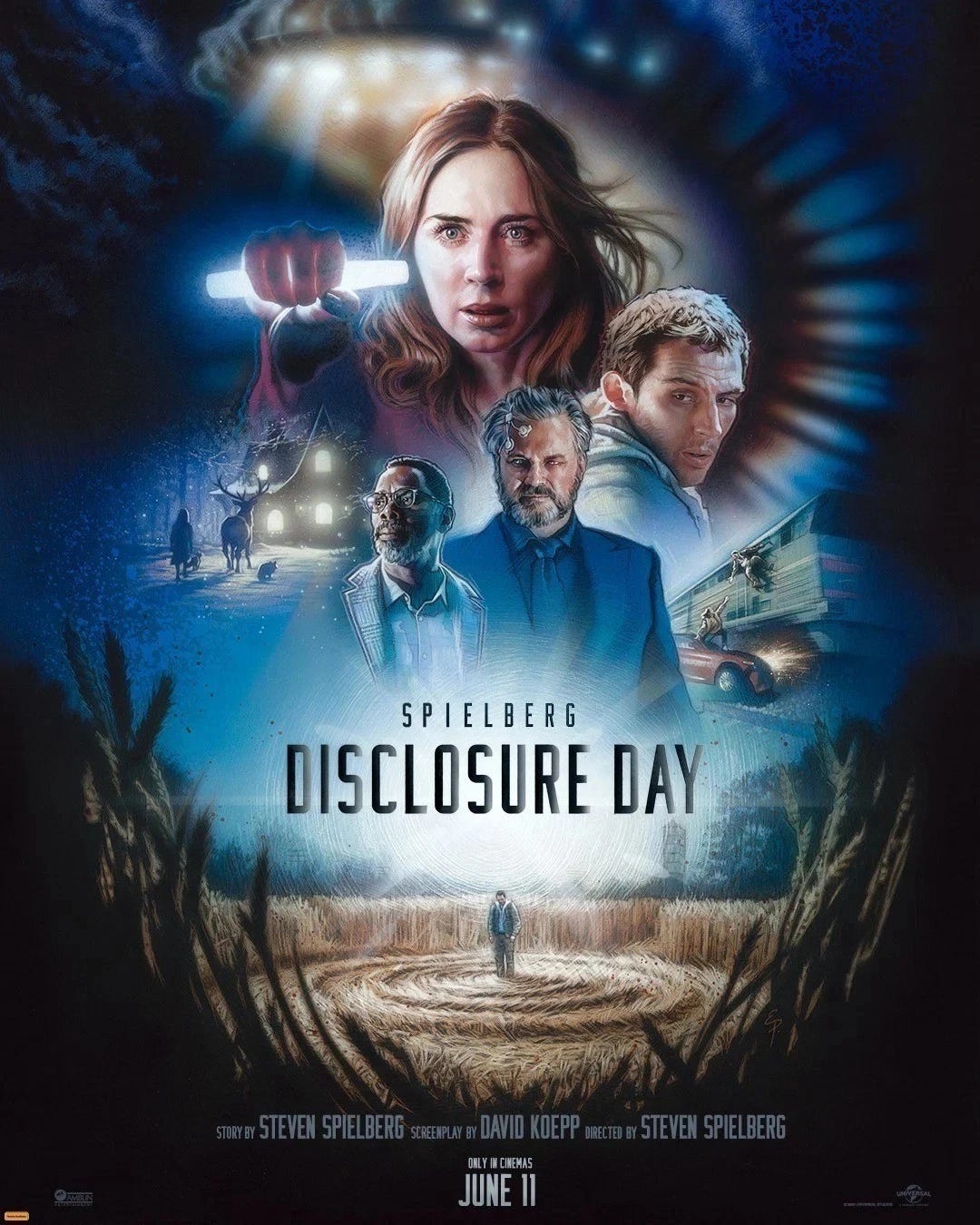
Image: Disclosure Day poster, Amblin Entertainment.
Into this atmosphere comes the original king of the summer blockbuster, Steven Spielberg, with his return to sci-fi (he spent a decade or so in the Oscar half of my movie year). The originator of a wide swath of the most beloved summer blockbusters (Jaws, ET, Raiders of the Lost Ark, Jurassic Park, I don’t need to go on) returns to summer with an original story of his own creation (fleshed out in a screenplay by Jurassic screenwriter David Koepp). The film is a spiritual (and not, as rumor suggested, a literal) descendent of Close Encounters of the Third Kind and ET, and I would even note some clear resonances with the much-maligned Indiana Jones and the Kingdom of the Crystal Skull. It is in every way a product of this arrested development culture (the Universal marketing is playing the nostalgia card HARD), and yet it is a breath of fresh air in its originality and storytelling.
I will not pretend in any way to have approached this film objectively. On our recent magnum opus of a podcast (The Spielberg Draft), I explained my relationship to Spielberg to my Long Take Review colleagues as the rom-com cliche where a character is desperately in love with a hottie way out of their league, but slowly comes to find that they love the dependable best friend who’s actually been there for them all along (I see you, Obsession, you deployed this brilliantly). In other words, despite my deep love of flashier directors (Wes Anderson, Alfonso Cauron, The Coen Brothers), it’s Spielberg who has been a regular dependable fixture in my life from my youth onwards. There are really only a couple films (Always, 1941) I don’t see myself revisiting ever again, but even if I never do, I’m still glad I saw them.
I entered Disclosure Day with expectations high (it was my number one pick in the Long Take Review Hype Draft this year), and those expectations were fueled by that desire to get an experience of substance that wasn’t solely interested in reminding me of the past. Who but Spielberg could I rely on to yet again shift the paradigm and find a way to inspire me anew?
While I can’t say the film was a complete knockout on the level of my favorite Spielberg films, I am very comfortable saying this was a cut above the usual summer blockbuster fair, and an even bigger cut above what we’ve seen so far this year (Masters of the Universe, I am talking to you).
(Last warning, the spoilers are finally going to roll! Go see it, and then come finish)
At its heart, Disclosure Day is an homage to the conspiracy thrillers of the 1970’s, with a sci-fi framing of the goal being to reveal that aliens have lived among us on earth for 70 years, and a shadowy government operation (Wardex) has worked across that period to exploit the aliens and their technology, and discredit everyone who ever suggested the aliens exist. Within the frame of the movie, this is primarily a hunt for Daniel Kellner, played by Josh O’Connor (Given less to do here than in Wake Up, Dead Man, but just as wonderfully sympathetic) who has stolen a copy of Wardex’s complete archive as well as a magical alien device (cue Arthur C Clarke).
While this setup and framing aren’t totally unique and original, the presentation of this plotline is. We join the action en medias res (remember this, you’ll need it for the Odyssey), and spend the first half hour or so playing catch up on the complete circumstances of Kellner, the theft, and the director of this action, Hugo Wakefield (played with effortless charm by Coleman Domingo). In the theater, this was my first indication that Spielberg was back: I was terribly confused.
In my surveying of internet reactions, I’ve seen similar confusion being lobbed as a marker of bad writing, of poor character development, or just of a boring first hour of the movie. I see in this the brain rot effects of an increasingly large set of adults (stop just calling it out in only teenagers). Confusion and a lack of information frustrate us because we lack the attention necessary to follow through and complete the puzzle on our own. But confusion is good for us. The dissonance motivates us to engage more deeply and think more critically.
As has been well documented (Such as here, by Matt Damon), Netflix is actively training us to half-watch films while we second screen or split our attention on household tasks. Netflix Executives (though they deny it) encourage creatives to repeat the plot and the meaning of scenes every 15 minutes or so to facilitate this, and I would argue it is breeding lazy film viewers. Spielberg, on the other hand, doesn’t clearly say it once. If you’re not locked in or not willing to do the work, then your relationship to the art will be completely unfulfilling (Again, I see you, Obsession).
By the end of the film, we get the complete picture, but only if we assembled the pieces: Hugo Wakefield worked inside of Wardex for Noah Scanlon (a masterful Colin Firth). Some time ago, Hugo came to understand that the actions of Wardex were deeply wrong, and inspired by the cruelty and torture Wardex broadly, and Scanlon directly, inflicted upon the aliens, Hugo helped an alien (In Vivo 17) escape from captivity and enter hiding. He then recruited Kellner, when the time was write to work at Wardex and eventually radicalized him against the corporation.
Either after 17 was freed, or more likely before it, the aliens have set in motion a second plot to smooth the disclosure: years ago they visited two children, O’Connor’s Kellner and Morgan Fairchild, played in a powerhouse bravura performance by Emily Blunt, imbuing each with a gift to help them prepare the way. Kellner (a name that beautifully translates from the German for steward) is granted a deep understanding of mathematics and the intricacies of the cosmos, including the aliens, and Fairchild (I assume I don’t need to interpret this name) is granted the ultimate superpower: empathy, and the ability to understand all humans, seeing into them and comforting them.
In the 20 years between those visitations and the start of the movie, Hugo has worked with the alien to help recruit from within Wardex, and on the morning of the day the movie starts, the plan created by the alien and Hugo is put into action, including an alien visitation to “activate” Fairchild, leading eventually to the titular disclosure day, where the full archive will be released and an alien will appear on live television to begin a new age of…?
And there is the giant plot choice that will (undoubtedly and I imagine deliberately) divide audiences. The film ends with a whispered message from the alien to Daniel Kellner and then a deep breath from Margaret Fairchild before she says “Listen…” and the screen cuts to black. I have no doubt every theater in America, like mine, had an angry guy give a sarcastic guffaw at this moment, and I get it. We live in an age where we need our art to tell us everything. But there is beauty in this too: the indeterminacy is far more powerful than any answer could have been. I smiled in response, knowing that Spielberg was leaving it up to me, and that the next part of the story was mine.
Part of why this movie hits so hard is that this is, undoubtedly, among the final stories Spielberg will give to us. Wishing him no ill fortune (and desperately wanting to see the Western he is now developing), it seems clear that there is only going to be one or two more Spielberg films after this one, as he wants to enjoy his time in the company of his family and friends (and presumably at Knicks games with Spike Lee).
Here then, in this near final at-bat, is the man that has spent a lifetime teaching us about the world and how to act in it (everything from the kindness of ET to the deeply felt pain of reckoning with the Holocaust in Schindler’s List) offering us the accumulation of this wisdom: “listen.”
Emily Blunt’s Fairchild is granted a super power beyond reckoning: the ability to make brief eye contact and suddenly understand the whole of who a person is and what ails them. Yet repeatedly, from police officers, to coworkers, to conspiracy comrades, every single time she uses that power, it is to express an understanding of who each individual is and to comfort them. In the world of this film, which is our world, we see that the superhero of the age of individuals stuck with their faces in their screens is simply to let people know that they are seen, that they are real, and that they are valued. By contrast, when Scanlon gains similar powers through the device, he uses it to take control, to force actions and to create violence. Subtly, across the run time, we watch these powers help Fairchild come alive and Scanlon wither unhealthily1.
The ending of the film, which I am sure half the internet is deriding as hopelessly naive, is perfect to me. Spielberg is doing what we’ve all been asking the baby boomer generation to do: leave, and let us take over. By amping up the contexts of geopolitical strife in the background across the runtime, Spielberg acknowledges the hopeless divisions in our world, but he responds radically with the firm belief that, if confronted, we might finally reject the Scanlons (a Musk/Bezos techno billionaire) of this world who profit off division, and find each other once again.
The perfect avatar of this, in an absolutely jaw-dropping performance, is Courtney Grace, the national news anchor narrating the final revelations of the film and interpreting them for her audience (and us). Channeling Walter Kronkite’s steady but wavering reactions to events from history, Grace hits this pitch-perfect note that triggers us to remember that these images and videos are powerful because they make us feel. When we see her glassy-eyed reactions, we get to fill in our own, and we get a helping of that beautiful Spielberg-ian wonder he’s been giving us for 50 years (Smile, you son of a…). It’s a beautiful rendering of one of the oldest tricks in drama the greek chorus. In the anchor’s reactions we more deeply understand the humanity within the moment. In other words, empathy.
So, when that crash to black happens and we get to sit in the dark theater as John Williams’s score (perhaps his final one!) helps us process what we saw, we get to understand ourselves and our world just a bit better and with just a bit more magic than when we began. Is there anything higher we could ask of a summer blockbuster?
In many ways, this felt akin to the respective highs and lows of Killers of the Flower Moon and Megalopolis. In those two films, Martin Scorsese and Francis Ford Coppola similarly seemed to reconsider themselves, contextualize their careers, and impart what message they’d want to leave us all with. For Coppola (and this may have been a fever dream) it was when the Pledge of Allegiance to the Human Race appeared on screen for the audience to recite along with the characters, and for Scorsese, it was when he appeared at the end as the storyteller within the radio play adapting the events of the film. Successful or not (strike that, reverse it), these filmmakers, and Spielberg, are reminding us that their films have been a mediation: a path for understanding some basic truths that they want to understand. They are art in its highest form…and also Megalopolis.
I’ll close this by noting the simple pattern that the mediation has taken in Spielberg’s films. Taken as a trilogy, his alien pictures of Close Encounters of the Third Kind, ET, and Disclosure Day have demonstrated the ways we can process difficult ideas across the range of our life’s journeys. The first, Close Encounters, asks questions about what it means to have a purpose in life, and how we find meaning and deal with the cost of that purpose. The second, ET, reminds us that this life is lonely and full of pain, but also deeply joyful. Even when we are lonely, love “will be right here.” And finally, Disclosure Day tells us, that despite all we have seen, all we understand, and all the world has shown us, we will be alright. We have each other and that could be, should we choose empathy over division, all we really need. The image at the top of this blog encapsulates that: two characters alone and overwhelmed, scared of their personal and global contexts, and yet they are together, and thereby they can find their way through2.
In the end, that’s what makes Spielberg my rom-com true love: he doesn’t encourage me to dwell in the mindless nostalgia of my youth, but instead he forces me to engage in the now3. He challenges me to understand this world and all I can be in it. He asks me to keep questioning, keep imagining, keep growing, and keep telling stories. He simply asks us all to “Listen…”
One can’t help but think Spielberg is channeling his buddy George Lucas’s basic definition of the light side and dark side: selflessness vs. selfishness. Only one is the path to true immortality. BTW (because I can’t fit this in elsewhere!) it’s also quite clear Steven has seen the sequel trilogy too…forcetime calls, a dyad…bestill my porgs.
I’m leaving War of the Worlds out of this grouping, but you could actually place its post-9/11 anxieties in the chronology to show the nature of letting the fears and divisions win.
Holy shit, is that what he was doing in his adaptation of Ready Player One?